
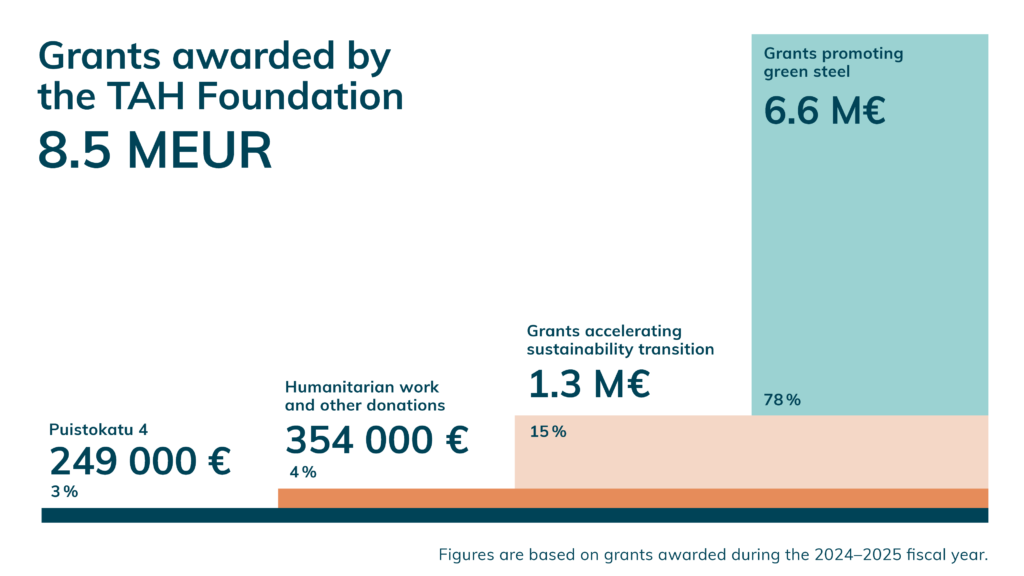
During the 2024–2025 financial year, we allocated approximately €8.5 million to projects advancing solutions to the climate crisis, accelerating the sustainability transition, and supporting societal well-being. Most of our funding focused on reducing emissions in the steel industry. In spring 2025, we updated our strategy for 2025–2030, reaffirming our commitment to rapid and scalable emissions reductions.
Seven of the nine planetary boundaries have now been exceeded. According to the Planetary Health Check 2025 report, published by the Potsdam Institute for Climate Impact Research and the Planetary Guardians network, ocean acidification crossed its threshold this year as well.
With more than three-quarters of Earth’s life-support systems operating outside safe limits, environmental degradation continues across all affected areas. At the same time, developments such as ozone layer recovery and declining aerosol pollution demonstrate that coordinated action can still reverse harmful trends.
Addressing the climate crisis requires both concrete action and significant capital. We are therefore continuing the work launched during the previous strategy period.
“Our updated strategy guides our work through 2030. Our goal is to finance projects that deliver rapid and scalable emissions reductions, leverage the power of networks and capital, and build collaboration nationally and internationally.”
Henna Hakkarainen, Executive Director
More than €8.5 million for climate initiatives
A vast majority, approximately €6.6 million of our funding was directed to reducing emissions from steel production. In total, we supported 22 projects that influence investors, increase demand for green steel, and contribute to climate regulation and policy development at the EU and Nordic levels.
We supported initiatives aimed at enabling the use of low-carbon steel in the construction sector and advancing regulation on steel reuse. At the EU level, we funded advocacy and standards work through cooperation with the Brussels-based organization ECOS.
To support corporate commitments and improve supply-chain transparency, we backed SteelZero by Climate Group, which provides tools for verifying steel emissions and sustainability performance.
Internationally, we continued our support for The Sunrise Project’s Lead the Charge initiative, which works to steer automotive manufacturers toward more responsible steel sourcing.
We also funded projects to strengthen the social acceptance of wind power and improve dialogue around the infrastructure required for the green transition. To this end, we funded a set of initiatives that includes research by the University of Eastern Finland on anticipating conflicts related to wind power, as well as a project by Akordi to develop a practical model for addressing conflict-prone issues. The model provides tools for local dialogue, particularly in matters related to wind power and land use.
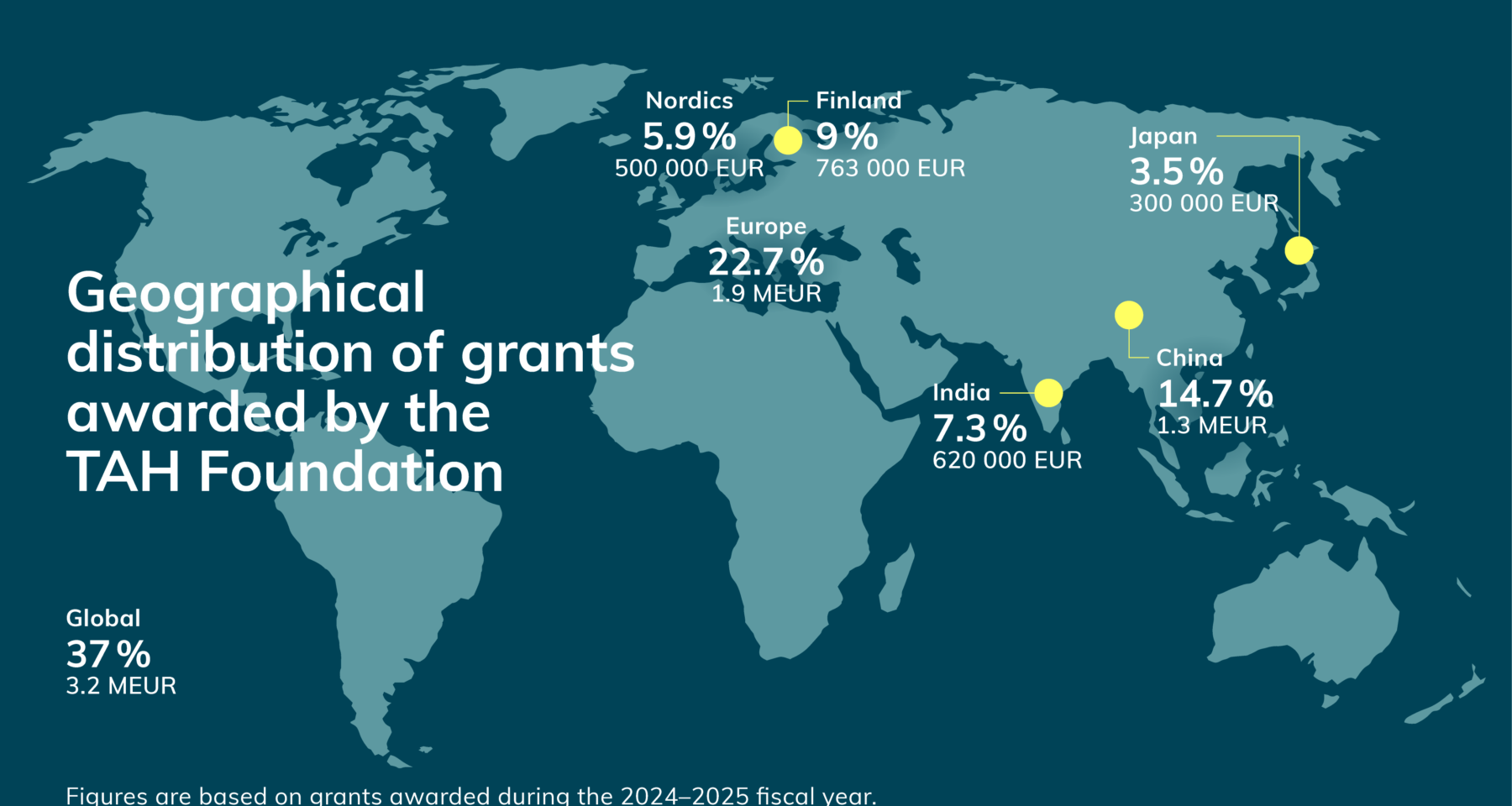
Several of the projects we funded focused on identifying emissions-reduction pathways and piloting solutions in China and India, where the majority of global steel production takes place.
“Most of the world’s steel—and its associated emissions—is produced in Asia. International cooperation is strength; our funded projects aim to advance global emissions reductions. It is important to create diverse pathways for cutting steel emissions. They will make emissions reductions easier to achieve in China and India as well.”
Harri Lammi, Head of Environmental Projects
Partners such as ACCR, Transition Asia, and Carbon Tracker work directly with investors engaging Asian steel producers. Project partners such as ACCR, Transition Asia, and Carbon Tracker communicate directly with investors who are also in dialogue with the Asian steel companies they own. Carbon Tracker is an independent think tank, Transition Asia an expert organization, and ACCR an investor-engagement NGO, but they are united by a shared goal: to steer investors toward more ambitious climate action—and the first results are already beginning to emerge.
“Japan’s largest steel producers, Nippon Steel and JFE Steel, have been the focus of international investor engagement for several years. Both companies have announced plans to replace traditional blast furnaces with lower-emission electric arc furnaces, and over the past year these plans have begun to materialize into concrete investment decisions.”
Iina Heikkilä, Environmental Specialist
To strengthen investor collaboration, we convened an international strategy meeting in Raasepori with 23 organizations from Europe, Asia, and the United States.
Recognizing the importance of networks, we also invited Laurence Tubiana, one of the architects of the Paris Agreement, to Finland. During her visit, she met with more than 100 Finnish decision-makers from politics, business, and public administration to advocate for stronger climate ambition.
In addition, we organized a closed-door dialogue on the societal acceptance of the green transition together with several Finnish business, environmental, and mediation organizations.
Beyond project funding, we worked to address financing and commercialization barriers that slow the scaling of climate solutions.
”While many of the technologies required for the green transition already exist, their deployment at the necessary scale remains constrained by a significant financing gap. We see foundations as well placed to act as catalytic and patient actors, helping unlock substantially larger volumes of market-based capital.”
Oona Poropudas, Project Manager
Broader sustainability and well-being initiatives
In addition to our steel-focused work, we supported projects advancing the sustainability transition more broadly. These included funding for an open-access textbook for energy engineers on renewable energy systems, support for the English translation of journalist Juha Kauppinen’s book on climate change and biodiversity loss, a youth environmental summit in Nuuksio, and work by the Science Based Targets Network to promote science-based nature targets among companies.
“We cannot succeed in reducing emissions unless we understand the sustainability challenge more broadly as staying within planetary boundaries. We have wanted to support important openings in the public debate that approach sustainability in a more holistic way.”
Harri Lammi, Head of Environmental Projects
We also awarded the Blue Globe environmental prize for the fourth time, recognizing initiatives that address overconsumption. On the humanitarian side, we continued our support for organizations such as Doctors Without Borders, the World Food Programme, and UNICEF. In Finland, cooperation between five foundations enabled more than 10,000 children and young people to participate in nature excursions.
Our mission is to accelerate the transition to a sustainable future through significant emissions reductions, systemic solutions, and changes in human behavior. During the year, we became the first Finnish foundation to join the international Philanthropy for Climate commitment and signed the Finnish Academy of Science and Letters’ sustainability transition statement.
At Puistokatu 4 – House of Science and Hope, we continued to foster multidisciplinary collaboration and societal dialogue. Nearly 50 researchers work at Puistokatu, representing 20 universities or research institutions. They include both professors and early-career doctoral researchers from more than 30 disciplines. Research at Puistokatu spans fields such as sustainability science, media studies, anthropology, pharmacy, and psychology.
More than 30 member organizations working at Puistokatu 4 represent foundations, activism, civil society organizations, the corporate and financial sectors, as well as art and culture. They bring expertise to Puistokatu in areas including sustainability consulting, journalism, and graphic design.
“Our annual member surveys have shown that cross-pollination between researchers and practitioners has fostered not only new ways of thinking, but also novel forms of collaboration that depart from conventional models.”
Minttu Jaakkola, Executive Director, Puistokatu 4
Over the past year, we organized dozens of public events, reaching approximately 2,000 visitors and contributing to a broader understanding of pathways toward an ecologically sustainable future.